
If you've opened your electric bill recently and experienced sticker shock, you aren't alone. Across the District of Columbia and the broader mid-Atlantic region, consumers are seeing higher monthly totals.
When bills increase, Pepco customers can turn to the Public Service Commission of the District of Columbia (DCPSC) for protection in what has become a volatile market. The reality of how electricity is priced (and who controls those prices) is more complex than it appears on the surface.
Looking beyond the District's borders can help customers understand why electric bills are so high and better understand the regional forces operating behind the scenes.
Breaking down your electric bill: delivery vs. supply
Before diving into market forces, it's crucial to understand how your bill is structured. Your electric bill is fundamentally split into two main categories, delivery and supply.
Delivery charges
This covers the cost of physically bringing electricity to your home or business. It pays for the local poles, wires, transformers, and the maintenance required to keep the grid reliable. The DCPSC strictly regulates these charges. Utilities cannot increase delivery rates without a rigorous, transparent legal review process (known as a "rate case") at the Commission. Adjustments to delivery rates have an effect on your bill, but the dramatic spikes many customers are seeing are primarily happening on the supply side of the bills (see below).
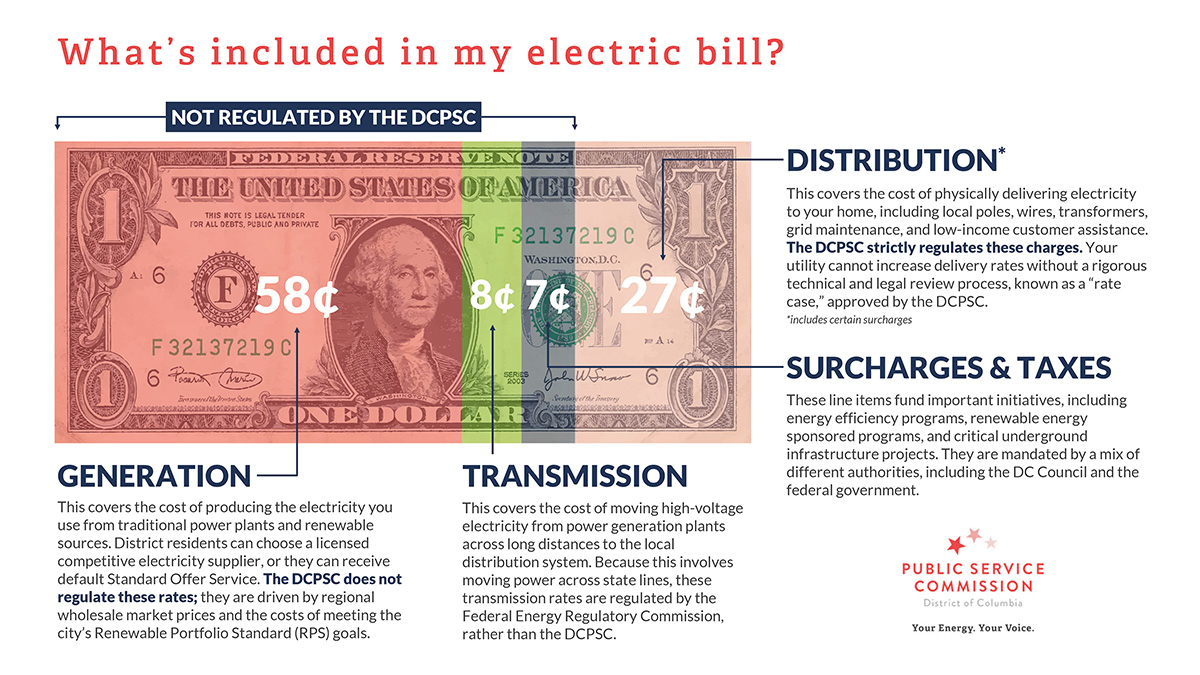
The delivery section of the bill also includes various taxes and surcharges that fund low-income assistance, energy efficiency programs, renewable energy programs, and critical infrastructure projects. These line items are mandated by a mix of different authorities, including the DCPSC, the DC Council, and the federal government. As of 2026, the DCPSC is only responsible for regulating about 27% of a standard Pepco bill (which includes base distribution rates and specific Commission-approved surcharges). The remaining 73% of costs are driven by regional supply prices and mandates from legislative bodies.
Supply charges (generation and transmission)
This is the price of the actual electricity you consume and the cost of transmitting it from power plants to the local distribution grid. Unless you have chosen a third-party supplier, you receive your supply through Pepco’s Standard Offer Service (SOS). The DCPSC does not set the cost of electricity supply. These prices are determined by the regional wholesale energy market.
Watch a brief explainer video for a closer look at where to find these charges on your bill.
Where does your energy dollar go?
While the video above outlines the broad concepts of your electric service, seeing the actual math can be eye-opening. For every dollar you spend on a typical electric bill, here is exactly how that money is divided and which specific portions the Commission actually regulates.
What's driving up the cost of electricity?
The increases you see on your bill are largely driven by the supply side of the equation. When the cost to generate and buy electricity on the regional grid goes up, the supply charges on your bill go up.
The District does not have any traditional power plants and must import nearly all of the power it consumes. The city is part of a massive regional power grid operated by PJM Interconnection that manages the flow of electricity across 13 states and the District. The DCPSC is also a member of the Organization of PJM States, Inc. and advocates for containing PJM costs and protecting District residents from harm.
Several converging market forces are also driving wholesale electricity prices higher:
- Surging regional demand
The demand for electricity in the mid-Atlantic is growing at an unprecedented rate. This "load growth," as it is formally called, is largely driven by the rapid expansion of energy-intensive data centers in neighboring states, alongside the broader adoption of EVs and the electrification of home heating. Because the regional grid is interconnected, the costs of ensuring enough power to meet this surging demand are shared by all customers, including those in the District. When demand increases, wholesale prices rise.
- Retiring power plants and tightening supply
As older, less efficient fossil fuel power plants are retired across the region, the overall supply of available electricity shrinks. Because new energy projects (like wind and solar facilities) are not coming online fast enough to seamlessly replace them, this tightening supply, combined with high demand, creates a more expensive wholesale market.
- Strict reliability requirements
Grid operators must ensure there is enough power available during extreme conditions, such as severe winter storms or summer heatwaves. Acquiring this "resource adequacy,” or capacity, costs money and those premiums are reflected in the wholesale market price.
- Transitioning to clean energy and the generation backlog
Moving the grid to cleaner power sources requires interconnection to the PJM regional grid. However, the grid is currently experiencing a severe bottleneck. While older power plants are retiring, new energy projects frequently face years of administrative, supply chain, and construction delays before they can actually connect to the grid. Because this new generation isn't coming online fast enough to replace the retiring plants, the region's overall energy supply remains exceptionally tight, keeping wholesale prices high.
The District's CleanEnergy Act also mandates that 100% of the city's electricity supply come from renewable sources by 2032, with 15% of that generated within the District by 2041. Funding this transition impacts everyone's bill.
Electricity suppliers participate in the District's Renewable Energy Portfolio Standard (RPS) program and are legally required to purchase Solar Renewable Energy Credits (SRECs) or pay compliance fees in order to meet these climate goals. Because of these ambitious targets, SREC prices in the District are considerably higher than anywhere else in the country. This has encouraged many District residents and businesses to install solar generation systems, but SREC payouts are ultimately funded by all customers. In 2024 alone, an estimated $50 million increase in compliance costs was passed directly onto consumers' supply charges.
What the DCPSC controls (and what it doesn't)
A common misconception is that the DCPSC sets the price of electricity or automatically approves utility requests to charge you more for power. The DCPSC does not set wholesale market prices, nor does it control the regional supply-and-demand forces of the PJM grid. The Commission's role when it comes to the supply portion of your bill is only oversight and consumer protection.
If you're an SOS customer (meaning you haven't chosen a third-party supplier), Pepco buys your electricity on the wholesale market through annual competitive auctions. The Commission's role is to monitor these auctions to ensure they are fair, competitive, and designed to secure the lowest possible market rate for customers at that time. The DCPSC ensures the utility does not profit from operating the auctions and does not pass unwarranted costs onto residents. However, the Commission cannot shield consumers entirely from the reality of a more expensive regional energy market.
Taking control of your electricity costs
While regional market forces dictate the baseline cost of electricity, you still have power over your monthly bill.
Compare offers from third-party suppliers
Pepco customers are not required to use the default Standard Offer Service. In the District, residents can choose a competitive third-party energy supplier. Depending on the market, you may be able to lock in a lower fixed rate or choose a supplier that uses 100% renewable energy.

Visit DC Power Connect to compare approved suppliers and learn how to switch safely.
Improve energy efficiency
The cheapest energy is the energy you don't use. Small changes to your daily habits, upgrading to LED lighting, and improving your home's insulation can dramatically reduce your consumption. The DCPSC Electric Bill Calculator can help you estimate how changes in your usage will impact your bottom line.
Access financial assistance
If you are struggling to keep up with your utility bills, help is available. District residents may be eligible for a variety of discount programs, payment plans, bill credits, and weatherization assistance. Contact the DCPSC Office of Consumer Services to learn more or visit #Here2HelpDC to find resources and see if you qualify.